


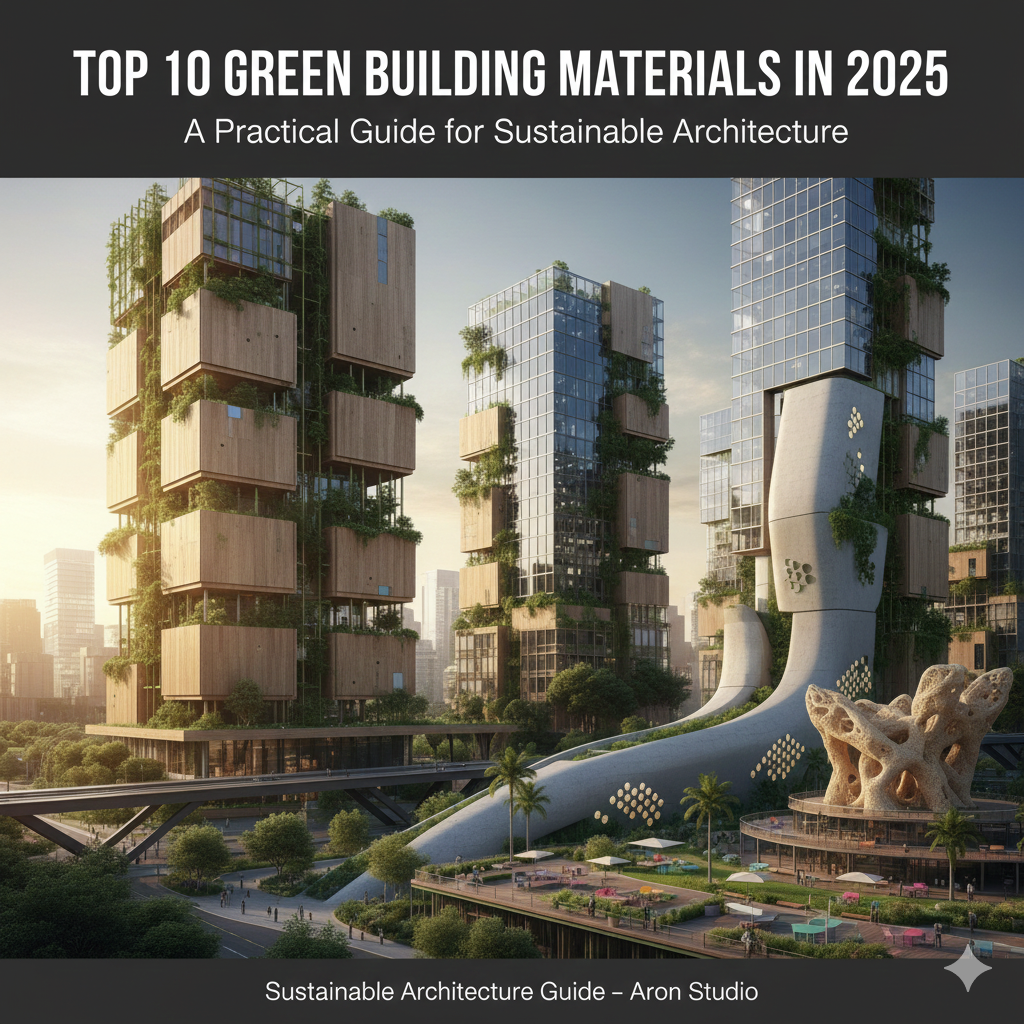
Top 10 Green Building Materials in 2025: A Practical Guide for Sustainable Architecture
The global construction industry is entering a new phase where sustainability is no longer optional — it is the foundation of every responsible architectural decision. In 2025, green building materials have moved far beyond a trend; they now directly influence cost-efficiency, user well-being, and long-term environmental impact. Architects, developers, and builders are increasingly turning toward solutions that reduce carbon footprint, enhance energy efficiency, and offer better lifecycle performance.
This article introduces the top 10 green building materials in 2025, focusing on their practical applications, environmental benefits, and relevance for modern construction projects.
Cross-Laminated Timber (CLT)
CLT has become the backbone of modern timber construction. Its engineered layered structure provides high strength, seismic resistance, and excellent insulation.
Benefits: Renewable resource, low embodied carbon, rapid installation.
Use cases: Mid-rise buildings, modular housing, educational facilities
Recycled Steel
Recycled steel offers the durability of conventional steel with a significantly reduced environmental impact, thanks to closed-loop recycling.
Benefits: Extremely strong, 100% recyclable, long lifespan.
Use cases: Frameworks, high-load structures, roofing
Hempcrete
Made from hemp fibers and lime, Hempcrete is one of the most eco-friendly insulation materials.
Benefits: Vapor-permeable, carbon-negative, lightweight.
Use cases: Wall infills, insulation, low-rise architecture.
Mycelium-Based Composites
Mycelium — fungal root fibers — is reshaping the bio-construction industry.
Benefits: Fully biodegradable, grown not manufactured, excellent insulation.
Use cases: Acoustic panels, interior walls, lightweight non-load structures
Recycled Plastic Composites
Made from post-consumer plastics, these composites prevent tons of waste from entering landfills and oceans.
Benefits: Moisture-resistant, durable, versatile.
Use cases: Facade panels, decking systems, outdoor furniture
Low-Carbon Concrete (Geopolymer Concrete)
This modern formulation replaces Portland cement with industrial by-products such as fly ash.
Benefits: Up to 80% lower carbon emissions, high durability.
Use cases: Foundations, pavements, structural components
Aerogel Insulation
Aerogel is one of the lightest solid materials in the world with unmatched thermal performance.
Benefits: Ultra-high insulation, moisture control, thin application.
Use cases: Facades, retrofitting historic buildings, roofs
Phase-Change Materials (PCMs)
PCMs help regulate indoor temperatures by absorbing and releasing heat.
Benefits: Increased energy efficiency, stable indoor climate.
Use cases: Walls, ceilings, HVAC-integrated systems
Smart Glass
Smart glass changes opacity with electricity or sunlight.
Benefits: Reduces heat gain, improves lighting control, supports energy-efficient design.
Use cases: Office buildings, facades, modern residential designs
Conclusion
The shift toward green architecture is accelerating, and 2025 marks a decisive moment: materials must be both high-performance and environmentally responsible. From low-carbon concrete to mycelium composites and CLT structures, sustainable materials are shaping the future of global architecture. For architects and developers aiming to meet modern standards — ecological, economic, or regulatory — these materials provide a clear pathway toward responsible, future-proof design.

